
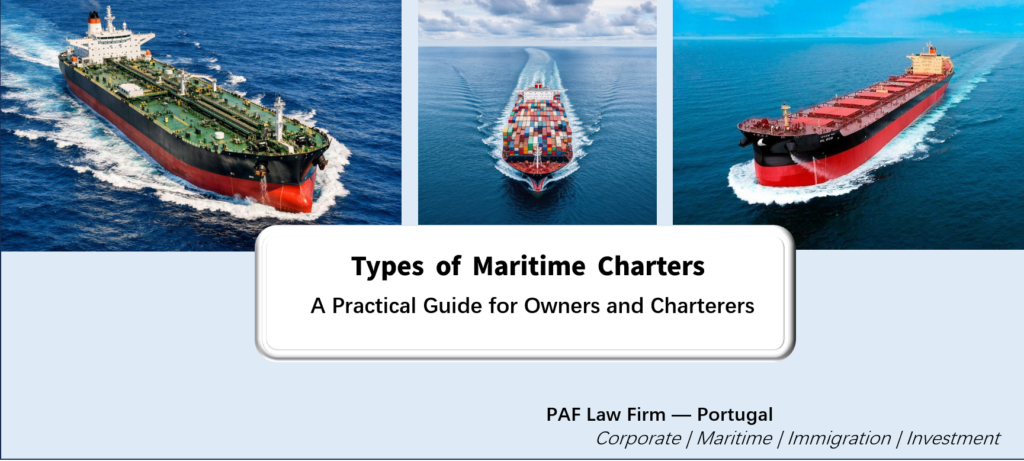
In shipping, choosing the right charter structure isn’t a formality — it’s the decision that determines who controls the vessel, who bears the operational risk, and who pays for what. Confusing a time charter with a voyage charter can be the difference between a profitable deal and an arbitration dispute in London. Here’s a guide to the eight most common structures.
1. Voyage Charter
The vessel is hired to carry a specific cargo between two or more agreed ports, for a single voyage. The owner retains operational control of the ship and crew; the charterer pays freight, usually per ton carried or as a lump sum. This is the classic structure for one-off cargo movements — simple in concept, though laytime and demurrage clauses are usually where the real contractual battles happen.
2. Time Charter
The vessel is placed at the charterer’s disposal for a fixed period — months or years — in exchange for daily or monthly hire. The owner continues to operate the ship technically (crew, maintenance), but the charterer decides the routes and cargoes carried during that period. It gives the charterer commercial flexibility, but demands close attention to off-hire clauses and redelivery terms.
3. Bareboat (Demise) Charter
The charterer takes full possession and control of the vessel, including responsibility for crewing and operating it as if it were their own. Payment is made as periodic hire. This is the preferred structure for parties wanting to operate the vessel autonomously — and, in the RIN-MAR context, it’s also the most common contractual basis for the bareboat charter registrations we’ve been handling.
4. Contract of Affreightment (COA)
Rather than chartering a specific vessel, this is a commitment by the owner to carry an agreed quantity of cargo over multiple voyages within a set period. It’s typical for regular bulk flows — coal, iron ore, fertilisers — where the client wants predictable capacity without tying itself to a single ship.
5. Trip Time Charter
A hybrid variant of the time charter, limited to one or a few specific voyages rather than a fixed period. The charterer pays daily hire for the duration of the contracted trip. It’s used when the operational flexibility of a time charter is wanted, but confined to a particular route or region
6. Consecutive Voyage Charter
Several successive voyages under a single umbrella agreement, between the same ports or routes. The owner retains control of the vessel; freight is paid per voyage. Suited to regular, repeated cargo movements, where negotiating a fresh contract for every voyage would be inefficient.
7. Slot Charter
The charterer buys a fixed number of container slots aboard another operator’s vessel, without any control over the ship itself. This is the standard structure among liner companies, NVOCCs and freight forwarders, particularly under slot-sharing agreements in container trades.
8. Space Charter
Similar to a slot charter, but broader: the charterer reserves a portion of the vessel’s cargo capacity, not necessarily limited to containers. It serves cargo volumes that don’t justify chartering the whole vessel.
In Summary
Structure | Who controls the vessel | Payment basis |
Voyage | Owner | Freight per voyage |
Time | Charterer (commercially) | Daily/monthly hire |
Bareboat | Charterer (fully) | Periodic hire |
COA | Owner | Contract terms |
Trip Time | Charterer | Daily hire |
Consecutive Voyage | Owner | Freight per voyage |
Slot | Owner/Operator | Per slot |
Space | Owner | Per space booked |
The right choice depends on the degree of operational control each party wants, the risk profile each is prepared to assume, and the law governing the contract — which is rarely, as it happens, Portuguese law by accident. If you’re structuring or reviewing a charter, or considering registering your vessel under RIN-MAR, PAF Law Firm has direct experience across this range of transactions, from contract drafting to dispute resolution.